Trane AC Capacitor: Your Complete Guide to Function, Failure, and Replacement
As HVAC business owners and contractors, we know that reliable equipment is the backbone of our service. When a client’s Trane AC unit isn’t performing, one of the first suspects on your troubleshooting list is often the capacitor. It’s a small component, but its failure can bring an entire system to a grinding halt, leaving your customers sweating and you with an urgent service call.
Understanding the intricacies of this vital component is not just about fixing a problem; it’s about providing top-tier service and minimizing costly callbacks. This guide will walk you through everything you need to know about the capacitor for trane ac unit, from its fundamental role to identifying failure and selecting the right replacement. Our goal at AC Direct VIP is to equip you with the knowledge and resources to keep your business running smoothly and your clients comfortable.
Key Highlights
- Capacitors are critical for starting and running Trane AC compressor and fan motors.
- Common failure signs include humming, delayed starts, or the unit not cooling.
- Proper diagnosis and selection of the correct MFD and voltage ratings are essential for replacement.
- Quality replacement parts from reputable suppliers like AC Direct VIP ensure system longevity.
- Preventative maintenance extends capacitor life and overall system reliability.
What is an AC Capacitor and Why is it Crucial for Your Trane Unit?
Every Trane air conditioning unit, whether a traditional split system or a modern packaged unit, relies on capacitors to function correctly. Think of a capacitor as a temporary battery or an energy reservoir for the electric motors within the AC system. Its primary job is to store electrical charge and then release it quickly to provide the necessary torque to start motors and maintain their efficient operation.
Without a properly functioning capacitor, the compressor motor or the outdoor fan motor simply cannot begin its cycle or maintain its speed. This is especially true for the robust compressors found in Trane units, which require a significant initial surge of power to overcome inertia and begin compression. For packaged HVAC systems often found on rooftops or alongside multi-floor homes, where all components are housed in one cabinet, the reliability of these capacitors is paramount, as a single failure can halt both heating and cooling functions.
Understanding the Role of Capacitors in Trane Air Conditioners
Capacitors in Trane AC units generally serve two distinct purposes: starting and running. Some units use separate start and run capacitors, while others, particularly many modern Trane models, use a dual run capacitor that handles both functions for two different motors – typically the compressor and the outdoor fan motor. This dual-purpose component simplifies wiring and can be a common point of failure for both critical parts of the system.
The start capacitor provides a large burst of power to initiate the motor’s rotation. It’s designed for short bursts and typically disconnects from the circuit once the motor reaches a certain speed. The run capacitor, on the other hand, stays in the circuit continually while the motor is operating. Its role is to optimize the motor’s efficiency, creating a phase shift in the alternating current that allows the motor to run smoothly and with less energy consumption. This distinction is important for technicians because diagnosing the specific type of capacitor failure helps in pinpointing the exact issue, whether it’s a motor struggling to start or one running inefficiently.
Signs Your Trane AC Capacitor Might Be Failing
Identifying a failing capacitor is a crucial diagnostic skill for any HVAC professional. The signs are often clear, but they can sometimes be mistaken for other, more serious issues. Here are the common indicators:
- Humming Noise But No Start: This is perhaps the most classic sign. You’ll hear the outdoor unit hum loudly, indicating the compressor or fan motor is receiving power but lacks the initial jolt to start spinning. Without the capacitor, the motor simply can’t overcome its own inertia.
- Delayed Start: The outdoor unit struggles to start, perhaps clicking several times or attempting to turn on, then shutting off, before finally engaging after a delay. This suggests a capacitor that is weakening and taking longer to build enough charge.
- Unit Not Cooling Effectively: If the compressor capacitor is weak, the compressor might run but not at full efficiency, leading to inadequate cooling. Your customers will report warm air or that the system runs constantly without reaching the set temperature.
- Outdoor Fan Not Spinning: The compressor might be running, but the fan above it isn’t turning. This often points directly to the fan side of a dual run capacitor or a dedicated fan capacitor. Without the fan, the unit will overheat and eventually trip a safety switch.
- Visibly Swollen or Leaking Capacitor: While not always visible without removing the component, a capacitor that is physically bulging at the top or showing signs of leakage (often a brownish fluid) is definitively bad. This is a clear indicator of internal failure due to excessive heat or age.
When you encounter these symptoms in a Trane unit, especially in a packaged system where all components are enclosed, a capacitor check should be among your first steps, utilizing your multimeter to test its microfarad (MFD) rating.
Common Causes of Capacitor Failure in Trane HVAC Systems
Capacitors are designed to last, but they are not immortal. Several factors contribute to their eventual demise, and understanding these can help you educate your clients on preventative measures and diagnose issues more accurately. For hvac systems in general, and Trane units specifically, here are the primary culprits:
- Heat: This is the number one enemy of capacitors. The extreme temperatures found in outdoor AC units, especially during peak summer operation, accelerate the breakdown of the dielectric material inside the capacitor. Trane units are built tough, but internal heat from prolonged operation or poor airflow can still take a toll.
- Age: Like any electronic component, capacitors degrade over time. Their internal chemistry slowly breaks down, reducing their ability to hold a charge. Most capacitors have a lifespan of 10-15 years, but this can vary wildly based on operating conditions.
- Voltage Spikes: Power surges, even minor ones, can stress a capacitor beyond its design limits. While Trane units have some built-in protections, sustained or significant voltage fluctuations can cause premature failure.
- Hard Starts: If a motor is struggling due to other issues – such as a tight compressor, low refrigerant, or a dirty condenser coil – the capacitor works harder, shortening its life. Each time it provides that initial jolt, it experiences a small amount of wear.
- Incorrect Sizing or Installation: Installing a capacitor with an incorrect MFD rating or voltage can lead to its premature failure. An undersized capacitor will work too hard, while an oversized one might cause other motor issues. Improper wiring can also lead to overheating or short circuits.
For packaged systems, which are exposed directly to external elements and can sometimes suffer from restricted airflow if not properly maintained, heat and age often play an even more pronounced role in capacitor degradation.
Types of Capacitors for Trane AC Units: Start Capacitors vs. Run Capacitors
When dealing with Trane air conditioning units, you’ll primarily encounter two types of capacitors, or a combination of both:
Start Capacitors:
- Function: Designed to provide a very high torque boost for a fraction of a second to get the motor spinning from a standstill. They are typically much larger in microfarad (MFD) rating than run capacitors.
- Design: Usually enclosed in a black plastic case, they often look different from run capacitors. They are not designed for continuous operation and are quickly taken out of the circuit by a relay (like a potential relay or current relay) once the motor starts.
- Failure Mode: Often fail “open,” meaning they no longer pass current, or “shorted,” which can trip breakers. A weak start capacitor will result in a motor humming but not starting.
Run Capacitors:
- Function: Provide a continuous phase shift to optimize motor efficiency and reduce current draw during operation. They are essential for continuous, smooth running of the motor.
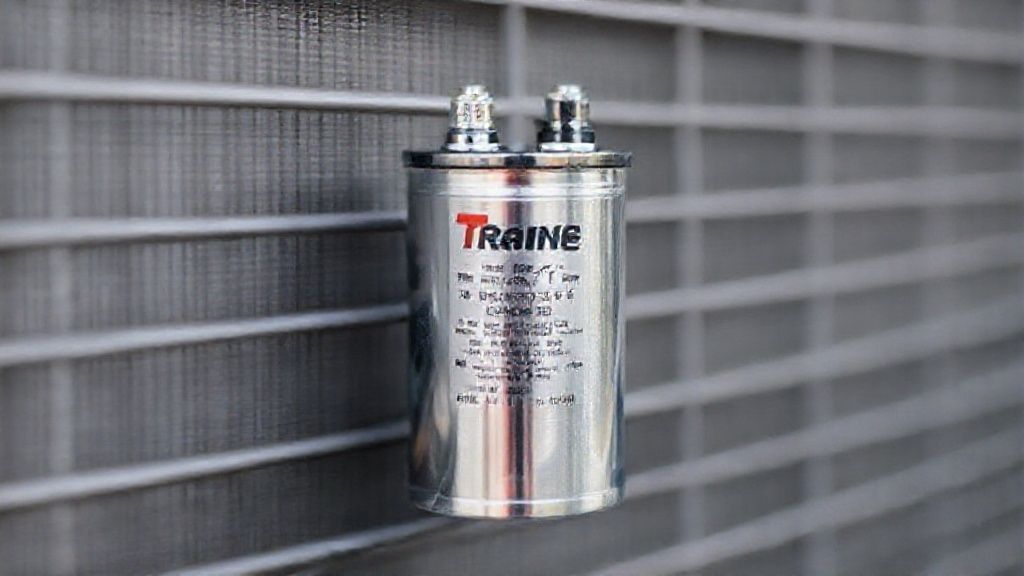
- Design: Typically housed in a metal (aluminum) can. They have a lower MFD rating compared to start capacitors and are designed for continuous duty.
- Dual Run Capacitors: Many Trane units, especially residential and light commercial models, use a dual run capacitor. These combine two capacitors into one metal can, usually with three terminals: “Herm” for the compressor, “Fan” for the outdoor fan motor, and “C” for common. This is a common component in many of the packaged units we work on.
- Failure Mode: Often fail “shorted” or “weak,” meaning their MFD rating drops below specifications. A weak run capacitor will lead to motors drawing excessive current, overheating, and potentially failing prematurely, or simply running inefficiently.
Proper identification of whether you’re dealing with a dedicated start, dedicated run, or a dual run capacitor is your first step when diagnosing and ordering a replacement part. Always check the system’s wiring diagram if you’re unsure.
How to Identify the Correct Replacement Capacitor for Your Trane Unit
Accurate capacitor replacement is non-negotiable. Installing the wrong one can lead to further damage, inefficient operation, or even safety hazards. Here’s a professional approach to identifying the correct replacement:
1. Verify the Microfarad (MFD) Rating:
- The MFD rating (e.g., 40/5 MFD, 45 MFD) indicates the capacitor’s capacity. This must match the original capacitor exactly. A slight tolerance is usually allowed (typically +/- 5%), but sticking to the precise rating is best practice.
- For dual run capacitors, you’ll see two MFD ratings (e.g., 40/5 MFD), indicating the compressor side (40 MFD) and the fan side (5 MFD).
2. Check the Voltage Rating:
- The voltage rating (e.g., 370V, 440V) indicates the maximum voltage the capacitor can safely handle. You can always use a capacitor with a higher voltage rating (e.g., a 440V where a 370V was used), but never a lower one. Using a lower voltage capacitor will lead to premature failure and potential system damage.
3. Note the Physical Dimensions:
- While not directly affecting electrical performance, the physical size (height and diameter) is important for fitting the new capacitor into the existing mounting bracket and space within the Trane unit’s cabinet.
4. Confirm Terminal Configuration:
- Most dual run capacitors have three terminals (Herm, Fan, C), while single run or start capacitors have two. Ensure the replacement matches the original in terms of terminal type (spade or screw) and quantity.
5. Cross-Reference with Trane Specifications:
- If possible, cross-reference the capacitor with Trane’s specific parts list for the model number of the unit. This is the most accurate way to ensure compatibility. Many times, the OEM part number will be printed on the capacitor itself or found in the unit’s service manual.
Always disconnect power to the unit and discharge the old capacitor safely before handling it. This is not just a best practice; it’s a critical safety measure.
The Importance of Quality Parts and Professional Installation
When you replace a capacitor in a Trane unit, the quality of the replacement part and the precision of the installation matter significantly. We at AC Direct VIP understand that cheap components might save a few dollars upfront, but they almost always lead to costly callbacks and dissatisfied customers down the line. Using a generic, low-quality capacitor increases the likelihood of premature failure, which reflects poorly on your business.
High-quality capacitors, even those from third-party manufacturers, are built to higher standards with better dielectric materials and more robust construction. This translates to a longer lifespan and more reliable performance for your client’s Trane unit. For contractors operating in the competitive HVAC market, your reputation hinges on the reliability of your repairs.
Beyond the part itself, professional installation is crucial. This includes:
- Proper Discharge: Always discharge the old capacitor before removing it to prevent electrical shock.
- Correct Wiring: Ensuring all terminals are connected precisely as they were on the original, especially with dual run capacitors.
- Secure Mounting: The new capacitor should be securely mounted to prevent vibration damage.
- Post-Installation Checks: Verifying the unit starts and runs correctly, and ideally, checking the amperage draw on the motors to ensure they are within specification.
For packaged systems that might be located on rooftops or in less accessible areas, taking the time to do the job right the first time with quality parts minimizes future trips and improves efficiency, especially important for units compatible with zoning dampers that rely on stable electrical supply.
Maintaining Your Trane AC Unit: Beyond the Capacitor Replacement
Replacing a capacitor is often a reactive repair, but as professionals, we know that preventative maintenance is key to long-term reliability for all Trane wholesale ac units. Educating your clients on these practices not only adds value to your service but can also prevent future capacitor failures and other system issues.
Here are some maintenance points to emphasize:
- Regular Coil Cleaning: A dirty condenser coil impedes heat transfer, causing the compressor to work harder and longer, leading to increased heat and stress on the capacitor. Clean coils improve efficiency and reduce the overall load on electrical components.
- Proper Airflow: Ensure outdoor units have adequate clearance for airflow. Blocked vents or surrounding foliage can cause the unit to run hotter than designed, shortening component life. This is especially true for packaged units where proper airflow across the entire cabinet is essential.
- Annual System Checks: Encourage annual preventative maintenance. During these checks, you can visually inspect capacitors for bulging, test their MFD ratings, and identify early signs of weakening before a complete failure occurs. This proactive approach saves your clients from unexpected breakdowns during peak demand.
- Secure Electrical Connections: Loose wiring can cause resistance, generate heat, and lead to premature failure of electrical components, including capacitors. Checking and tightening connections during maintenance can prevent this.
- Proper Ductwork and Insulation: For any HVAC system, especially packaged units which offer whole-home coverage, the efficiency depends heavily on proper insulation and sealed ductwork. Leaky ducts or inadequate insulation make the unit work harder, increasing the operational stress on all components, including capacitors. Addressing these issues can indirectly extend capacitor life by reducing the overall workload on the system.
By offering comprehensive maintenance plans that go beyond just swapping parts, you position your business as a trusted advisor, not just a repair service.
Where to Find High-Quality Trane AC Capacitors and Parts
Sourcing reliable parts is fundamental to your business success. You need access to a wide selection of quality components, available quickly and at competitive prices. That’s exactly where AC Direct VIP comes in. We understand the demands you face as an HVAC contractor and business owner.
When you need a replacement capacitor for a Trane AC unit, whether it’s for a residential split system or a larger packaged unit on a commercial property, you can count on us. We stock a comprehensive inventory of capacitors with various MFD and voltage ratings to ensure you find the exact match for your repair. Our commitment is to provide you with:
- Quality Products: We source capacitors from reputable manufacturers known for their durability and performance.
- Competitive Pricing: We offer wholesale pricing designed to help you maintain healthy margins on your service calls.
- Convenient Access: Our online platform makes it easy to find and order the parts you need, whenever you need them, without the hassle of traditional distributors.
- Expert Support: We’re here to help you get the right part every time.
Don’t let a faulty capacitor slow down your business or compromise your service quality. Partner with AC Direct VIP for all your Trane AC capacitor and other HVAC parts needs. We’re here to help you get the job done right, the first time.
What Does a Trane AC Capacitor Do?
A Trane AC capacitor stores and releases electrical energy to help start and run the electric motors in the air conditioning unit. Specifically, it provides the initial surge of power needed to get the compressor and fan motors spinning, and then helps them run efficiently by maintaining a proper phase shift in the electrical current. Without it, the motors would struggle to start or operate correctly, leading to system failure.
How Can I Tell if a Trane AC Capacitor is Bad?
You can identify a bad Trane AC capacitor by several signs. The most common indicators include the outdoor unit humming but the fan or compressor not starting, the unit experiencing delayed starts, or the air conditioner running but not cooling effectively. Visually, a capacitor that is bulging at the top or leaking fluid is a clear sign of failure. For a definitive diagnosis, use a multimeter to test the capacitor’s microfarad (MFD) rating against its specifications.
Can I Replace a Trane AC Capacitor Myself?
While an HVAC professional with the right tools and knowledge can replace a Trane AC capacitor, it is not a DIY task for homeowners. Capacitors store high voltage even when the unit is turned off, posing a serious electrocution risk. Additionally, selecting the incorrect replacement capacitor (wrong MFD or voltage) can damage the entire unit. HVAC contractors should always prioritize safety and precise component matching for professional repairs.
What is the Difference Between a Start Capacitor and a Run Capacitor?
A start capacitor provides a large, momentary burst of power to overcome the initial inertia of a motor, quickly disconnecting from the circuit once the motor is up to speed. It’s designed for short-duration, high-power output. A run capacitor, on the other hand, remains in the circuit continuously while the motor operates, optimizing its efficiency and reducing current draw. Many Trane units utilize a dual run capacitor that serves both the compressor and the outdoor fan motor with continuous operation for both.
Why Do Trane AC Capacitors Fail?
Trane AC capacitors commonly fail due to a combination of factors. The primary causes are excessive heat within the unit, which degrades the internal dielectric material, and old age, as the capacitor’s chemistry naturally breaks down over time. Other contributing factors include voltage spikes from power surges, hard starts caused by other system issues (like dirty coils or low refrigerant), and improper sizing or installation of the capacitor itself. Regular maintenance can help mitigate some of these issues.
Final Thoughts
Understanding the ins and outs of Trane AC capacitors is a fundamental skill for any HVAC professional. From accurate diagnosis to selecting the right replacement and performing a quality installation, your expertise directly impacts your clients’ comfort and your business’s reputation. At AC Direct VIP, we’re committed to supporting you with the knowledge and the quality parts you need to tackle these common issues with confidence and efficiency. Keep these insights in mind on your next service call, and you’ll not only resolve the immediate problem but also build lasting trust with your clientele. Remember, a well-informed technician equipped with reliable parts is the backbone of a successful HVAC business.